Updated November 4, 2026: Amendment 3 passed on November 3.
Amendment 3 passed. If Panama City Beach is your full-time home and you have homestead, it should cut your property tax bill by about $1,080 a year by 2028, or about $1,354 if you live outside the city limits. If it's your second home or a rental, you don't get that break. What you get is a smaller limit on how fast your assessed value can go up. And if you're planning to move here full-time, December 31, 2026 is the date to know.
That's the short version. Here's the rest, as plainly as I can put it. (Or watch the video version. I recorded it before the vote, so where I say "if it passes," it did.)
Amendment 3 passed. What's the December 31 date?
The bigger exemption depends on when you became a Florida resident, not when you bought.
If you're a permanent Florida resident... | Your homestead exemption on the non-school part of your bill |
|---|---|
By December 31, 2026 | $150,000 in 2027, $250,000 in 2028, then adjusted for inflation starting in 2029 |
On or after January 1, 2027 | $50,000 (adjusted for inflation starting in 2028) for your first four years of homestead, then the full exemption starting January 1 of your fifth year |
Source: Pinellas County Property Appraiser's Amendment 3 FAQ and the Florida Senate. Bay County applies the same state rules.
Two things that surprise people:
- You don't have to buy by December 31. The Pinellas County Property Appraiser says people who are Florida residents by December 31, 2026 qualify for the higher amount "when they do choose to purchase a residential property and apply for homestead."
- Owning a second home here doesn't make you a resident. Residency is about where you actually live permanently. The property appraiser decides, using the same factors as today's homestead rules.
If you're thinking about making Panama City Beach your full-time home in the next year or two, that's a conversation to have with a CPA or attorney now, not in January. I can't tell you what counts as residency in your situation, but I can tell you the date matters.
What is Amendment 3?
It's a change to the Florida Constitution. Voters approved it on November 3, 2026. It needed 60% of the vote. It takes effect January 1, 2027.
It does four things:
- It raises the homestead exemption for full-time residents.
- It lowers the yearly cap on assessed value for everyone else, from 10% to 5%.
- It makes new Florida residents wait for the bigger break.
- It limits what cities and counties can spend property tax money on.
Your 2026 tax bill, the one arriving this month, isn't affected. The first bill with the change is November 2027.
What is taxable value? (It's not what your home would sell for.)
This trips people up, so it's worth a minute. Your property tax isn't figured on what your home would sell for. It's figured on your taxable value, which is usually a lot lower.
Here's how the county gets there:
What It Means | Example | |
|---|---|---|
Market Value | What your home would probably sell for | $500,000 |
Assessed Value | What the county values it at for taxes | $400,000 |
Minus Exemptions | Like the homestead exemption (non-school part) | -$51,411 |
Taxable Value | What your tax is actually figured on | $348,589 |
Example only. Your numbers are on your TRIM notice.
If it's your full-time home, a rule called Save Our Homes keeps your assessed value from going up more than 3% a year, even when the market jumps. So the longer you've owned your home, the further your assessed value usually falls below market value. Second homes and rentals have a looser limit of 10% a year, and that's the one Amendment 3 lowers to 5%.
A homestead exemption is the amount the county takes off your assessed value because the home is where you live full time. That's the number Amendment 3 makes bigger.
All the examples below use assessed value, not market value.
What's the $25,000 school exemption?
Your tax bill is really two bills added together. One part pays for the public schools. The other part pays for everything else: the county, fire, mosquito control and so on.
Your homestead exemption works differently on each part:
Before Amendment 3 | Now That It Passed | |
|---|---|---|
School Taxes | $25,000 off | $25,000 off (no change) |
Everything Else | Up to $51,411 off | $150,000 off in 2027; $250,000 in 2028 |
So Amendment 3 only touches the "everything else" part. The school part stays exactly the same. And in Bay County, school taxes are about half of a typical full-time homeowner's bill, which is a big reason the savings is smaller than people expect.
How much would a full-time homeowner save?
The "everything else" exemption goes from $51,411 to $150,000 in 2027 and $250,000 in 2028.
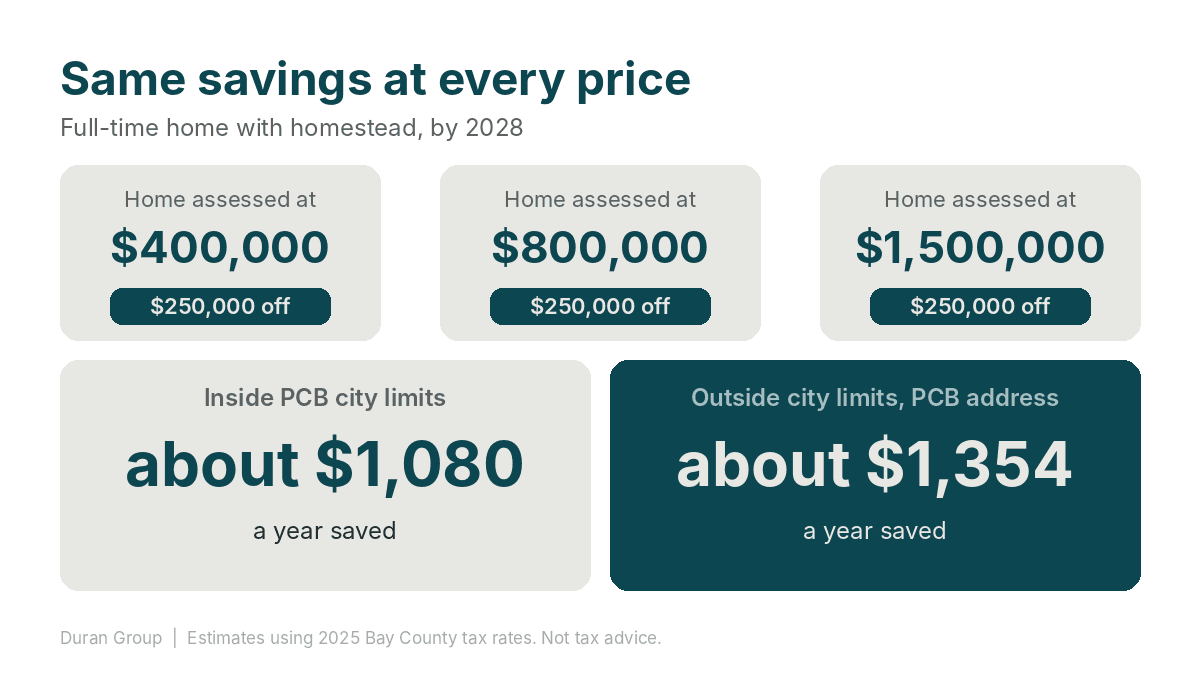
Here's the part that surprised me. The exemption is a flat dollar amount, not a percentage. So a home assessed at $400,000 and one assessed at $1.5 million save the same amount.
2027 | 2028 | |
|---|---|---|
Inside Panama City Beach City Limits | About $536 | About $1,080 |
Outside City Limits, PCB Address | About $672 | About $1,354 |
Estimates for a full-time home with homestead, using 2025 Bay County tax rates. Small levies left out.
One exception: if your assessed value is under $250,000, you'd save less. That's pretty common with people who have owned their homes a long time, because Save Our Homes has kept their assessed value low. So look at the assessed value on your tax notice, not what you think the house would sell for.
Why does it matter if I'm inside the city limits?
The City of Panama City Beach doesn't charge a property tax. It runs on its business tax. But a lot of homes with a Panama City Beach address aren't actually inside the city limits.
If you're outside, you pay the county's fire tax on top of the county rate. That means a little more for the exemption to come off of, so you save a little more. Your bill is still higher out there.
To check which side you're on, look up your property on the Bay County Property Appraiser's site. If it says "Tax District: City of Panama City Beach (District 13)," you're inside the city.
What would that do to my actual tax bill?
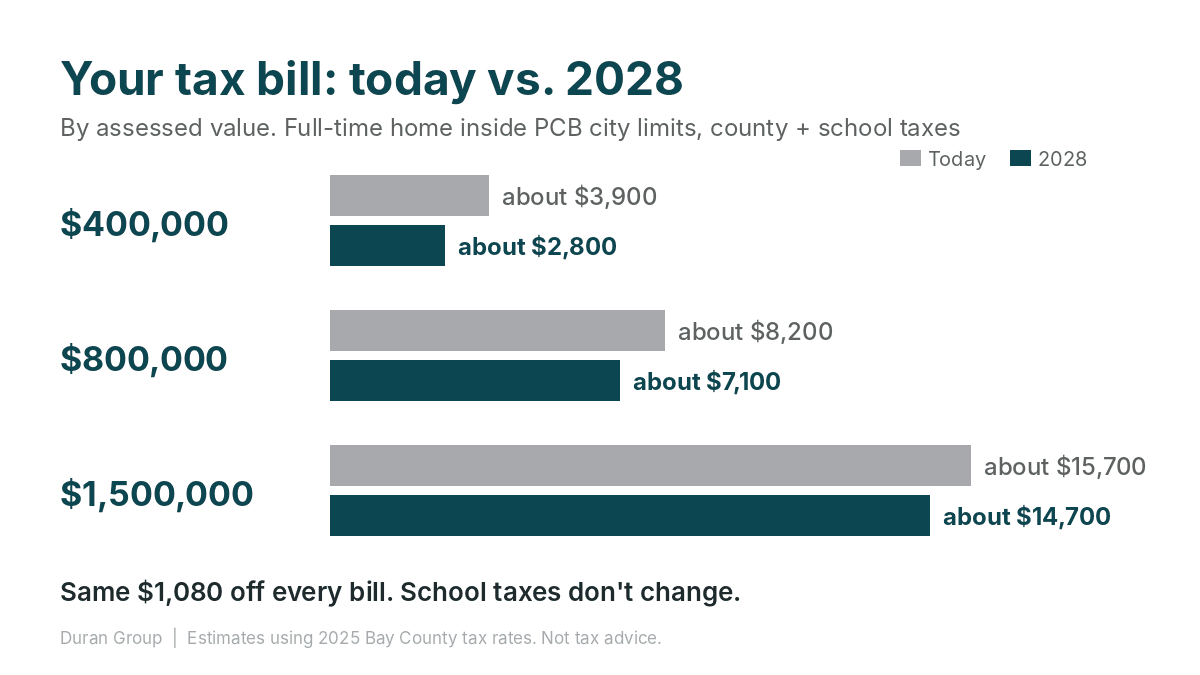
Assessed Value | Today | 2028 |
|---|---|---|
$400,000 | About $3,900 | About $2,800 |
$800,000 | About $8,200 | About $7,100 |
$1,500,000 | About $15,700 | About $14,700 |
Estimated county and school taxes, full-time home inside city limits, 2025 rates, values held flat.
Same $1,080 off every bill. On the smaller home, that's a real dent. On the bigger home, most of the bill is still there, because school taxes don't change at all.
So I'd tell you, if you've heard this wipes out property taxes, it doesn't.
What if it's my second home or a rental?
You don't get the new exemption. Not in 2027, not in 2028. Second homes have never gotten homestead, and this doesn't change that.
What you do get is a lower cap. Until now, the county could raise a second home's assessed value by up to 10% a year. Starting January 1, 2027, that's 5%. It applies to the non-school part of your bill only. School taxes stay on full market value.
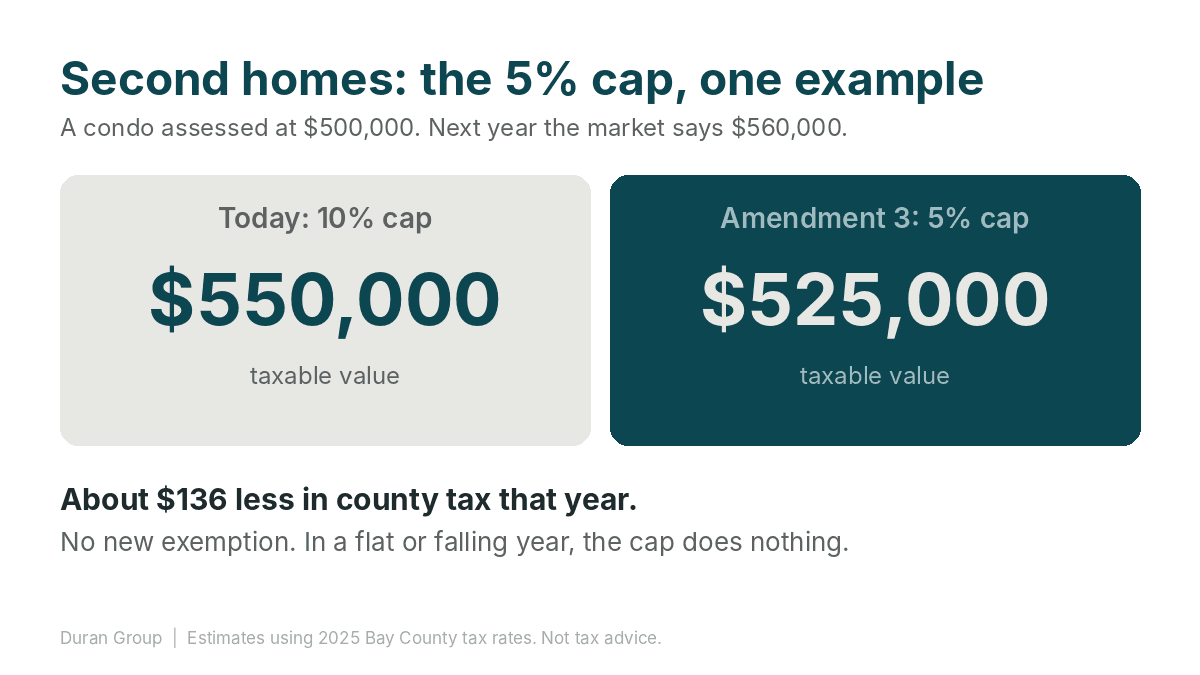
Say your condo is assessed at $500,000, and the next year the market says it's worth $560,000. Under the old 10% cap, the county could take it to $550,000. Under Amendment 3, only to $525,000. On the county's main tax rate, that's about $136 less that year.
Two things to know about that cap. It only helps in a year when values jump. When values are flat or going down, it does nothing. And it resets when the property sells, so a buyer starts over at full market value.
Honestly, most of the people I work with own a condo on this beach they don't live in. For them, this is a small thing in most years. It's not nothing. But it's not the headline.
What are the downsides?
The money full-time homeowners stop paying has to come from somewhere, or services get smaller. Governments across Bay County would lose about $38 million a year once this is fully in place, according to a News Herald estimate using the Property Appraiser's numbers.
Here's what critics point to:
Second homes could pay more. Nothing in the amendment stops tax rates from going up. If a city or county raises its rate to cover the gap, owners without homestead pay the whole increase. The 5% cap limits your value, not your rate.
Services could be cut. Fire, police, roads, libraries. No replacement money is named.
New residents wait. If you become a Florida resident after December 31, 2026, you start with a $50,000 exemption and get the bigger one starting in your fifth year.
It's hard to undo. It's in the constitution now. Changing it takes another statewide vote at 60%.
What do supporters say?
Full-time homeowners have been squeezed by rising values and rising taxes, and this is real relief. Local spending has grown faster than it needed to. School funding isn't touched. And second homes and rentals get steadier bills with a 5% cap instead of 10%.
Who's for it, and who's against it?
Florida Realtors is supporting it. Florida TaxWatch, an independent taxpayer research group, is recommending a no vote. Their point is that relief is needed by homestead and non-homestead owners alike.
Two serious groups looked at the same amendment and landed in opposite places. That told me it was a real trade-off, not an easy call. Voters have decided now, so the useful question is what it means for your property.
What should I do now?
- Check your homestead and your tax district on the Bay County Property Appraiser's site.
- If you're planning to live here full-time, look at the December 31, 2026 date with a CPA or attorney before the end of the year.
- If you're buying a home to live in, apply for homestead on time. The usual deadline is March 1 of the year after you move in. Check with the Bay County Property Appraiser.
- If you own a second home or rental, watch your August 2027 TRIM notice. It's the first one that will show the 5% cap.
- Keep an eye on the details. The Legislature still has to pass a law to carry some of this out, and some details may change.
A few questions I get
Does Amendment 3 lower school taxes? No. For school taxes, your homestead still takes off $25,000, the same as today. Only the non-school part of your bill changes.
If I buy a home here next year, do I get the full exemption? If you're a permanent Florida resident by December 31, 2026, yes, as it phases in, even if you buy later. If you become a resident after that, you start at $50,000 for four years and get the bigger exemption starting January 1 of your fifth year. Check with a CPA, because the Legislature may still fill in details.
Does it help condo owners who rent their unit out? Only through the lower cap, and only in years when values jump. Rental and investment property doesn't get the new exemption.
When will I see the change? On your August 2027 TRIM notice, and then your November 2027 tax bill.
I own a condo here and I'm thinking about moving here full-time. Does December 31 matter to me? It might. The date is about when you become a permanent Florida resident, not when you bought the condo. Talk to a CPA or attorney about your situation before the end of the year.
If you own here and want to look at what this means for your property, I'm happy to walk through it with you. Call or text me at 850-290-0417.
Sources: Florida Legislature HJR 1F and the revised ballot summary (Aug. 13, 2026) · House staff analysis of CS/HJR 1F (June 1, 2026) · Florida Senate President's release (June 2, 2026) · Pinellas County Property Appraiser, Amendment 3 FAQ · Bay County Tax Collector, 2025 millage rates · City of Panama City Beach · Panama City News Herald · WJHG · Florida TaxWatch · Florida Realtors · Kaufman Rossin · NBC6
Craig Duran is a broker with The Duran Group at Berkshire Hathaway HomeServices Beach Properties of Florida and has sold real estate in Panama City Beach since 2003. He's a real estate broker, not a tax advisor or attorney, and nothing here is tax or legal advice.